


 Muirfinn
Dispatch across gensets, batteries and shore power. The power management system keeps the plant safe.
First deployments from mid-2027. Muirfinn is not in service yet.
What goes wrong today
- A hybrid system not delivering the return it was bought for
- Gensets, battery and shore power each run to their own rules
- A battery held as a reserve, not used to save fuel
- Load peaks met by starting another genset
- Fuel burn the power management system was never set up to minimise
- Battery modes that shorten its life
- Power quality and condition only seen after a fault
- EU ETS, FuelEU and CII figures built from scattered logs
Where Muirfinn comes in
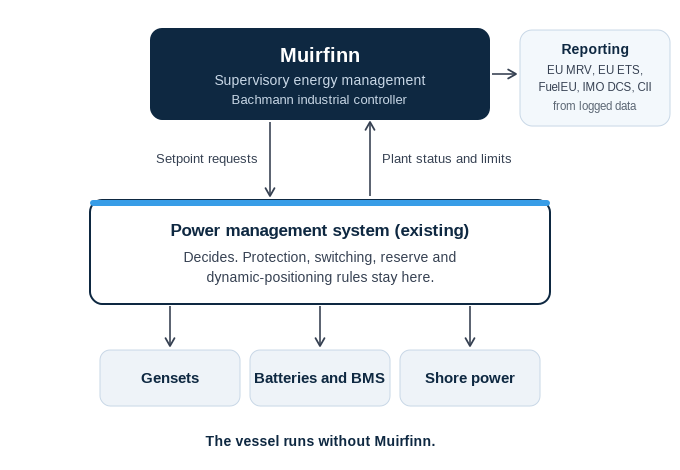
Muirfinn requests setpoints. The power management system decides. Protection and switching stay with the power management system, and the vessel runs without Muirfinn.
It is built on Bachmann industrial controllers and validated on hardware-in-the-loop with the production code.
What it does
- Dispatch
- Gensets, batteries and shore power, within the reserve and dynamic-positioning rules the power management system enforces.
- Fuel
- Modelled studies by DNV, Wärtsilä and CMAL put the fuel saving between 6% and 29%. We confirm the figure against your own baseline. It is a model result, not a saving measured on a vessel in service.
- Battery modes
- Seven operating modes, switched for efficiency and battery life, including ramp support, peak shaving and load levelling.
- Condition
- Power quality and asset condition, measured on board and trended against limits.
- Reporting
- EU MRV, EU ETS, FuelEU, IMO DCS and CII figures from logged data. Gaps are flagged and not filled in. For ships of 5,000 GT and above, EU ETS covers 100% of 2026 emissions.