


 Tirfinn
Your energy assets work on their own. Tirfinn makes them work as one site.
Tirfinn is in development, starting with factories and farms in Northern Ireland and the rest of Ireland.
What goes wrong today
- Solar and battery not paying back as expected
- Solar curtailed under a zero-export connection
- Paying every month for capacity you do not use
- Import peaks pushing past the agreed capacity
- A battery running on a fixed timer
- An export limiter that does not know about the generator
- Kit from several suppliers that does not work together
- Monitoring lost when a supplier goes
- Production stopped at short notice for demand response
- Non-energy charges taking a large share of the bill
Where Tirfinn comes in
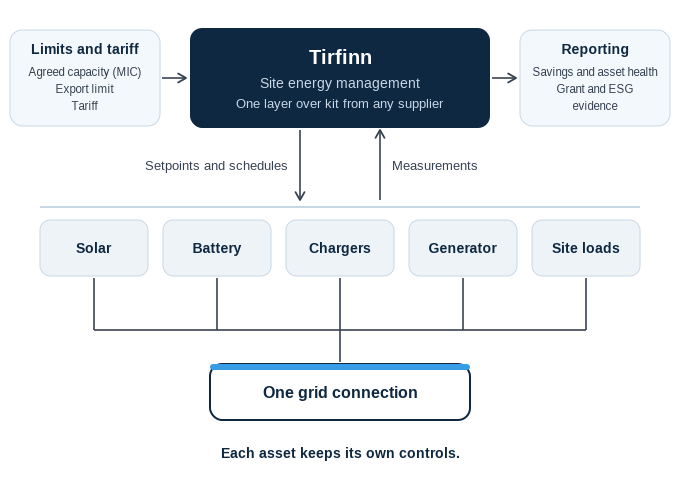
Most sites add energy kit one piece at a time: solar on the roof, then a battery, chargers, a standby generator, all behind one grid connection. Each works on its own. Nothing manages them together, so solar is curtailed under an export limit, the site pays for capacity it does not use, and the battery runs on a timer.
Tirfinn is the management layer above that kit. It works with the assets you already have, from whichever suppliers installed them. It is software and control, not another hardware sale.
What it does
- Grid limits
- Keeps import under your agreed capacity (MIC), manages zero or limited export, and shaves peaks, so more of your solar is used on site instead of curtailed.
- One layer over mixed kit
- Solar, wind, battery, CHP, heat pumps, EV and forklift charging from different suppliers, coordinated as one site.
- Tariffs and charges
- Moves flexible load to cheaper periods and reduces the non-energy charges on the bill.
- Demand response
- Answers grid requests by moving flexible load, instead of stopping production at short notice.
- Reporting
- Savings, asset health and evidence for grant and ESG reporting, in plain terms.
- Planned
- Battery dispatch that weighs cycle wear, generator loading that avoids light-load running, and early warning of harmonics from drives.
- Who it is for
- Small and mid-size factories, and farms and agri-food businesses: dairy, poultry, mushrooms, drinks, farm anaerobic digestion, meat processing and grain drying.